

Introduction
Over the past ten years, Linux gaming has undergone significant change. What was once considered a niche hobby for open-source enthusiasts is now a powerful alternative to Windows gaming. Thanks to tools like Steam Proton, Wine, Lutris, and cutting-edge GPU drivers, gamers can now enjoy thousands of AAA and indie titles directly on Linux. Yet, many users still struggle with performance bottlenecks, compatibility issues, and hardware optimization.
That’s where Tech Hacks PBLinuxGaming comes in. This guide is designed to help you unlock the full potential of your Linux gaming setup with innovative, practical, and proven techniques. Whether you’re aiming for higher FPS, smoother gameplay, better compatibility, or reduced latency, these hacks will help you fine-tune your system like a pro.
By the end of this article, you’ll have a complete roadmap to optimize drivers, tweak system settings, enhance compatibility layers, and boost performance ensuring a seamless Linux gaming experience.
Choosing the Right Linux Distribution for Gaming
Your gaming journey starts with selecting the right Linux distribution (distro). Not all distros are equally optimized for gaming performance and hardware compatibility.
With Tech Hacks PBLinuxGaming, choosing a gaming-focused distribution becomes easier, as modern distros simplify setup and driver installation ensuring fewer headaches, better stability, and smoother gameplay.
Key Gaming-Friendly Distros
- Pop!_OS: Excellent NVIDIA support out of the box
- Ubuntu: Large community support and stable repositories
- Manjaro: Rolling release with updated kernels and drivers
- Fedora Games Spin: Optimized for performance enthusiasts
- Nobara Project: Tailored specifically for gaming
Comparison Table
| Distro | Best For | Driver Support | Ease of Use | Performance Updates |
| Pop!_OS | NVIDIA users | Excellent | Very Easy | Frequent |
| Ubuntu | Beginners | Very Good | Easy | Stable |
| Manjaro | Advanced gamers | Excellent | Moderate | Rolling release |
| Nobara | Plug-and-play gaming | Excellent | Easy | Gaming optimized |
Choosing the right distro reduces compatibility friction and improves gaming stability.
Installing and Optimizing GPU Drivers
GPU drivers are the backbone of Linux gaming performance. Without proper drivers, even high-end hardware underperforms.
NVIDIA Users
- Install proprietary drivers from official repositories
- Enable nvidia-settings performance mode
- Use the latest Vulkan packages
AMD Users
- Use Mesa drivers (often pre-installed)
- Keep your system updated for the latest kernel improvements.
- Install mesa-vulkan-drivers
Intel GPU Optimization
- Enable Mesa Iris driver
- Keep kernel updated
- Use Vulkan for supported games
Proper GPU configuration can increase FPS by 15–30% in many titles.
Mastering Steam Proton for Compatibility
Steam Proton is a revolutionary compatibility layer that allows Windows games to run on Linux. Understanding how to tweak it is essential when applying strategies from Tech Hacks PBLinuxGaming to maximize performance and compatibility.
Essential Proton Hacks
- Enable Proton Experimental for the latest fixes
- Use Proton-GE (Glorious Eggroll) for better game compatibility
- Configure custom launch options such as:
Benefits
- Run thousands of Windows games on Linux
- Improve DirectX 11/12 compatibility through Vulkan translation
- Reduce crashes and stability issues in certain AAA games
ProtonDB provides community-tested configurations for thousands of titles, making it easier to apply the right tweaks. You can frequently overcome anti-cheat restrictions and improve overall gaming performance by mixing custom Proton builds with Tech Hacks PBLinuxGaming’s optimization techniques.
System Performance Tuning for Maximum FPS
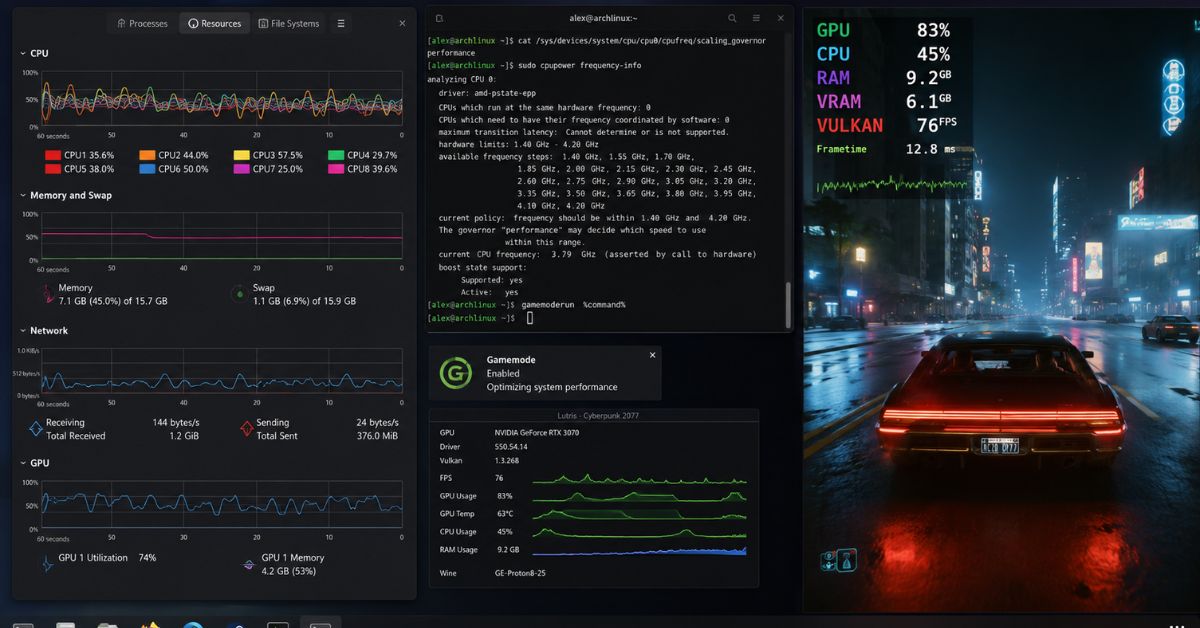
Optimizing your system beyond drivers can dramatically enhance gaming performance, and this is a core focus of Tech Hacks PBLinuxGaming.
Performance Tweaks
- Enable Gamemode
- Disable unnecessary startup services
- Set CPU governor to performance mode:
- Increase swappiness settings to optimize memory usage
Key Benefits
- Reduced CPU throttling
- Lower background resource usage
- Smoother frame pacing
Gamemode dynamically adjusts system performance during gameplay. When combined with the strategies from Tech Hacks PBLinuxGaming, these tweaks can significantly reduce stuttering and boost overall system responsiveness.
Using Lutris for Non-Steam Games
Not all games are on Steam. Lutris is a powerful open-source platform for managing games from multiple sources, and it plays an important role in expanding the possibilities highlighted in Tech Hacks PBLinuxGaming.
Why Lutris?
- Supports Epic Games Store
- Integrates Wine configurations
- Custom runner options
- Community install scripts
Best Practices
- Use the latest Wine-GE runner
- Check Lutris forums for updated install scripts
- Enable DXVK and VKD3D for better DirectX performance
By combining Lutris with the strategies from Tech Hacks PBLinuxGaming, you can ensure strong compatibility for both older Windows titles and modern game releases on Linux.
Vulkan and DXVK Optimization
Vulkan improves Linux gaming efficiency and reduces overhead compared to OpenGL.
Why Vulkan Matters
- Lower CPU usage
- Better multi-threading
- Improved frame pacing
Optimization Hacks
- Install the latest Vulkan packages.
- Monitor FPS and GPU load
Vulkan can improve FPS by up to 20% compared to legacy rendering pipelines.
Reducing Input Lag and Improving Latency
Competitive gaming demands low latency. Linux can be optimized for ultra-responsive gameplay.
Hacks for Lower Input Lag
- Enable Wayland for modern compositing
- Disable V-Sync if not needed
- Use a high-polling-rate gaming mouse
- Enable Low Latency Kernel
Benefits
- Faster response times
- Improved competitive performance
- Reduced screen tearing
Low-latency tuning is critical for FPS and esports titles.
Storage Optimization and Game Load Speeds
Slow load times ruin immersion. SSD optimization is crucial.
Storage Tips
- Use NVMe SSD for AAA games
- Enable TRIM support
- Mount with a no-time flag
- Separate gaming partition
Performance Impact
| Storage Type | Avg Load Time | Performance Impact |
| HDD | 40–60 sec | Slow |
| SATA SSD | 15–25 sec | Good |
| NVMe SSD | 8–15 sec | Excellent |
NVMe drives significantly reduce texture loading stutter.
Case Study: Optimizing a Mid-Range Linux Gaming PC
Let’s consider a real-world example. System Specs:
- Ryzen 5 3600
- 16GB RAM
- RX 6600 GPU
- NVMe SSD
Before Optimization
- Cyberpunk 2077: 45 FPS avg
- Occasional stutter
- High CPU usage
After Applying Tech Hacks to PBLinuxGaming
- Enabled Gamemode
- Updated Mesa drivers
- Used Proton-GE
- Switched to Vulkan
Results
- 60+ FPS average
- Reduced stutter
- Stable GPU temps
This demonstrates how systematic optimization transforms performance.
Security and Stability Best Practices
Security matters in Linux gaming, especially when applying advanced tweaks from Tech Hacks PBLinuxGaming to enhance performance.
Recommended Practices
- Keep your system updated.
- Avoid unofficial repositories
- Backup game saves regularly
- Use a firewall (UFW)
When using Tech Hacks PBLinuxGaming, adhering to these recommended practices guarantees long-term stability, security, and reliable gaming performance.
FAQs
Is Linux good for AAA gaming in 2026?
Yes. With Proton and Vulkan improvements, many AAA games run smoothly on Linux with near-native performance.
Do all Steam games work on Linux?
Not all, but thousands are compatible. Check ProtonDB for specific titles.
Does Linux improve FPS compared to Windows?
In some Vulkan-based games, yes. Results, however, differ according on optimization and drivers.
What is the best Linux distro for gaming beginners?
Pop!_OS and Ubuntu are beginner-friendly with excellent driver support.
How can I reduce stuttering in Linux games?
Install games on an SSD, enable Vulkan, update GPU drivers, and use GameMode.
Conclusion
Linux gaming is no longer experimental; it’s powerful, stable, and capable of delivering high-end performance when configured correctly. Through these You now know how to choose the best distribution, optimize GPU drivers, set up Proton, enable Vulkan, minimize latency, and improve storage performance thanks to Tech Hacks PBLinuxGaming.
By applying these techniques from Tech Hacks PBLinuxGaming, you can transform your Linux system into a fully optimized gaming machine capable of running modern AAA titles with impressive stability and smooth frame rates.
If you’re serious about getting the most from your Linux gaming setup, start implementing these hacks today. Explore community forums, test performance tweaks, and stay updated with the latest driver releases to maximize your results.